
Does size really matter? (Startups vs Corporates)
Where can you have the bigger impact? Written from my little work experience, a lot of reading, and talking to a person with more than 25 years of startup and corporate experience.

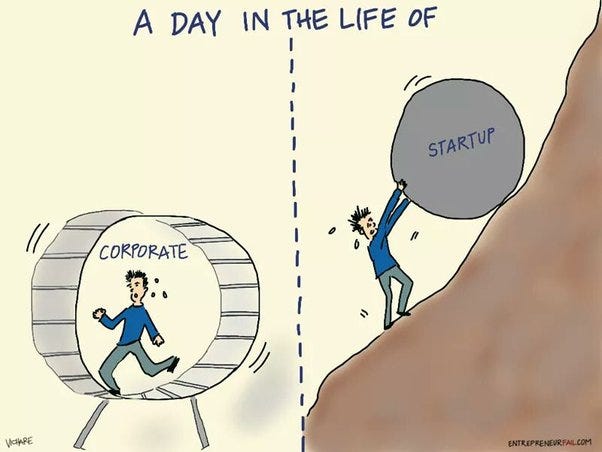
I don’t know from where I picked this up, but this notion of ‘Oh, think about the kind of impact you can have in a startup versus the impact you can have in a big corporation; obviously, you can have a bigger impact at a startup’ somehow caught onto me. I think I read this somewhere on Twitter and heard some people mention it in an interview. And it seemed evident that I couldn’t bring that big of a change to Google or Microsoft unless I were Sundar Pichai or Satya Nadella.
But then, I met one of Dad's friends, who had done his MBA at Columbia Business School and worked at Wells Fargo and the US Bank for almost 20 years. He is currently running a bootstrapped, B2B marketplace of daily essentials for restaurants, college cafeterias, bakeries, etc., in tier-2 cities of Tamil Nadu.
I was talking to him about what I was doing right now, and the first question he asked me was, “Thambi, what brings you to the startup world?”. I gave him many reasons, including what I said in the first paragraph. He carefully listened to me until I finished talking. Then he said, “Look, I headed technology in one of the biggest banks in the US during the end of my stint there, and what we built there is still being used by millions of people daily, and billions of dollars are processed through that system even today. So, don’t give into the thought that you can only create impact if you’re working in a startup.”
That also seemed obvious when he said that, but then I wondered why this thought didn’t come to me until then. I felt like, somewhere, I overlooked the impact of people working in big corporations because of all the hype about startups and founders in recent years. Subconsciously, I had concluded that if you work in a big corporation in the initial years of your career, you can only chase outputs, and you cannot chase outcomes. Startups are the only place where you can go after outcomes.
Output: Tangible deliverables that stem from activities or projects.
Example:
New Website Design: A marketing campaign that enhances the online presence and user experience.
Outcome: The actual changes or benefits that occur as a result of these outputs.
Example:
Higher Sales: An outcome indicating the success of marketing efforts in driving revenue growth.
And talking specifically about Product Management, when I was reading this article titled ‘Behind Every Great Product’, Marty Cagan talked about how behind every great product that he has seen, there is someone behind the scenes who is working tirelessly who led the product team to combine technology and design to solve real customer problems in a way that met the needs of the business, who might or might not have the title of a Product Manager.
He gives examples of 5 to 6 people who turned around products of big companies. Martina Lauchengco decided to have a separate codebase for ‘Word for Mac’; although it seemed counterintuitive, it worked brilliantly later. Or Kate Arnold, who introduced the subscription service on Netflix for their DVD business (believe me, Netflix used to be a DVD-selling company). Or Jane Manning, an Engineering Manager who convinced people in Google to introduce Google Adwords, the main cash cow of Google now (Google’s advertisement business alone contributes to 77% of Google’s total revenue as of FY2023).
While these were not the only ones responsible for bringing about the respective products, they had a significant impact. I read more about this, the two distinct variations come to light in general Product Management practices across companies. One is where the PMs are given a list of features to build and a roadmap to follow (output), and the second is where PMs take up problems faced by either the customer or the business and come up with solutions (outcomes). This seems to be true across companies of different scales. The former falls under a Project Manager’s role more than a Product Manager’s. And thanks to Marty Cagan once again, for making me understand this. And there’s no harm in being output-oriented if we’re clear with what we want to do.
So, I think being an output-oriented person, vs an outcome-oriented person has to do more with the person and their direct manager, than the company's scale.
If you’ve had experience on either side of the spectrum, tell me what you think. I am all ears.